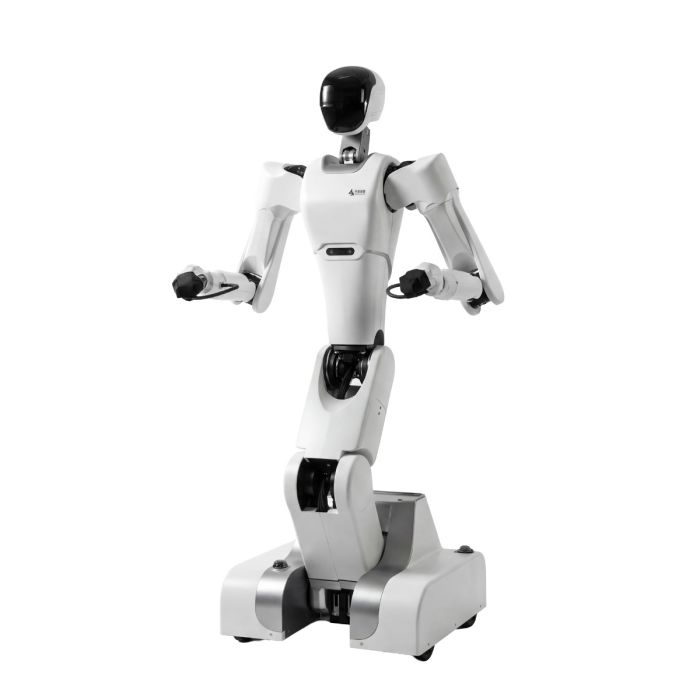
Astribot T1 Wheeled Humanoid Robot
In stock
- ماركة:
- ASTRIBOT
- نموذج:
- T1
- ORIGIN:
- الصين
- AVAILABILITY:
- SUBJECT TO AVAILABILITY
- SKU:
- Astribot-T1
Astribot T1
Most humanoids move like what they are — gearboxes wearing a human costume — because their muscles are motors bolted at every joint, each one adding mass, stiffness and that unmistakable servo jerk. The Astribot T1 moves differently because it is built differently: like its celebrated flagship sibling, the S1 whose impossibly fluid manipulation videos introduced the world to Shenzhen's Astribot, the T1 uses a cable-driven architecture — motors kept close to the body, power routed through tendon-like cables to the limbs — the anatomy that makes its motion smooth, compliant and fast where conventional drivetrains are stiff, heavy and abrupt. The T1's mission is to put that anatomy within ordinary reach. A compact wheeled humanoid at 1.55 metres and about 66 kilograms, it carries 23 degrees of freedom before its 16-DOF dexterous hands, lifts 5 kilograms per arm, and runs through multi-hour working sessions — a machine deliberately scaled, priced and packaged as the accessible counterpart to its near-flagship-cost sibling. The intelligence arrives as a complete stack the company calls Design for AI: the Lumo foundation models (the current Lumo-2 demonstrated at its North American debut autonomously tidying deformable objects into a backpack — soft-object manipulation, the category's hardest ordinary task), the Astribot OS embodied operating system with meta-packages, skill libraries, SDK and API access, and VR-based teleoperation for demonstration and data collection. Trained primarily on human demonstration data and improved by centrally retrained, over-the-air-delivered model updates, the T1 targets the tasks its training method implies: cooking assistance, laundry folding, laboratory operations, parts sorting, EV charging — and whatever its buyers teach it next, which is rather the point.
The Astribot T1 is available for purchase internationally through this page, with delivery, customs clearance and after-sales support arranged for buyers across the Americas, Europe, the Middle East, Asia-Pacific and worldwide — including immediate availability for United States customers following the platform's North American launch.
Background
From viral flagship to volume play
Astribot — formally Stardust Intelligence, founded in Shenzhen in December 2022 by Lai Jie after research posts at Tencent's Robotics X lab and Baidu — earned its reputation the honest way: its S1 manipulation demonstrations were so fast and so fluid that the industry's first reaction was suspicion, and its second was investment, with more than a hundred million dollars raised from backers including Ant Group and Matrix Partners China. The T1, launched in May 2026 after first appearing at the World Robot Conference and maturing through the published Astribot Suite research, is the strategic second act: the S1's defining technology — the cable-driven body — carried into a compact, wheeled, order-of-magnitude-more-accessible machine that trades legged spectacle for something the market wants more: manipulation that works, in a form factor that ships. The sequence accelerated through 2026 — US orders opened with immediate delivery around the platform's IROS debut in Pittsburgh, where the Lumo-2 demonstration ran before the global robotics research community.
A platform that proves itself in 36 hours
Astribot's boldest claim for the T1 is developer velocity, and it arrives with a timestamp: at the company's second Astribot OS hackathon in Beijing, fifteen teams built and demonstrated more than ten working applications on the T1 within 36 hours. That number is the stack working as designed. Astribot OS hands developers composable meta-packages and skill libraries rather than bare joint control; the SDK and APIs open the platform from agentic behaviour down to foundational functions; VR teleoperation turns a human session into training demonstrations; and the Lumo learning loop closes the system — deployment data flows back, models retrain centrally, capabilities return over the air or on site. The company is explicit about the honest boundary: the T1 does not learn autonomously in real time during deployment — it improves by that deliberate data-retrain-update cycle, the disciplined architecture serious operators prefer to black-box promises.
Technical Specifications
| Parameter | Astribot T1 |
|---|---|
| Type | compact wheeled humanoid — accessible sibling of the Astribot S1 flagship |
| Launched | May 2026; North American debut and US availability from September 2026 (IROS, Pittsburgh) |
| Height / weight | 1.55 m / ~66 kg |
| Degrees of freedom | 23 excluding end effectors |
| Hands | 16-DOF dexterous hands |
| Arm payload | 5 kg per arm |
| Actuation | cable-driven architecture inherited from the S1 — dexterous manipulation, compliant interaction, high-speed movement |
| Mobility | wheeled base; compact, portable, rapid deployment |
| AI | Lumo foundation models (currently Lumo-2); trained primarily on human demonstration data |
| Software | Astribot OS embodied operating system — meta-packages, skill libraries, SDK, API |
| Teleoperation | VR-based remote operation and demonstration collection |
| Learning model | centralised retraining on fleet data; OTA and on-site updates (no autonomous real-time learning in deployment) |
| Runtime | multi-hour operation (4–6 h cited in platform coverage) |
| Demonstrated tasks | deformable-object tidying, laundry folding, cooking assistance, lab operations, parts sorting, EV charging |
| Developer proof | 15 teams, 10+ working applications in 36 hours (Astribot OS Hackathon) |
Configuration options and current model capabilities are confirmed against the datasheet at quotation; task repertoire depends on training and provisioned skills.
Why do cables beat gearboxes at human work?
Because human work is contact work, and contact punishes stiffness. A conventionally actuated arm carries its motors in its joints: heavy limbs with high reflected inertia that meet the world abruptly, demand caution around people, and buzz through the micro-corrections fine manipulation requires. Cable drive relocates the muscle and transmits the force — limbs become light, backdrivable and compliant, able to absorb a bump, yield to a human touch, and move at the speeds that made the S1 famous while placing a grip gently enough for laundry. For the T1's chosen professions this is not refinement but qualification: folding a shirt, plating food and seating a charging connector are all tasks where the texture of motion decides success, and where a 66-kilogram machine working beside people must be mechanically polite by construction. The wheeled base completes the engineering honesty — indoor floors never required legs, and omitting them spends the entire budget where this market's value lives: in the arms, the hands and the tendons between.
Who is the Astribot T1 for?
For research laboratories and universities, the T1 is close to a category of its own: cable-driven manipulation hardware of viral-flagship lineage, a full OS-SDK-API stack, VR demonstration collection and foundation-model integration, at an accessibility that fleets rather than flagships are built from; for developers and startups, the 36-hour-hackathon platform — the fastest public path from idea to working humanoid application; for light-industrial and commercial operators piloting sorting, tending and service tasks where compliant contact and wheeled reliability beat bipedal theatre; for forward-deployed home and household-robotics programmes, the laundry-and-kitchen task family being exactly what demonstration-trained Lumo models are raised on; and for North American buyers specifically, a newly and immediately available platform with ordering open now. Operators requiring the flagship's full performance envelope will find the S1 above it in the same family — same tendons, larger ambitions.
What is the Astribot T1 used for?
- Embodied-AI research: manipulation, demonstration learning and foundation-model studies on cable-driven hardware.
- Application development: building and shipping skills on Astribot OS through SDK, API and skill libraries.
- Household-task automation: laundry folding, tidying and cooking-assistance programmes on demonstration-trained models.
- Laboratory operations: instrument handling and routine procedures in research and testing environments.
- Light industrial work: parts sorting, machine tending and service tasks in commercial settings.
- Teleoperated data collection: VR-driven demonstration capture feeding the Lumo training loop.
Pricing and Availability
The Astribot T1 is available for purchase and international delivery through this page, from single developer and laboratory units to multi-robot programmes, with United States orders fulfilled with immediate availability following the platform's North American launch and the flagship S1 quoted alongside where the full-performance tier fits the mission. Price and cost depend on configuration, software and skill provisioning, training scope and quantity, so buyers should request a current quotation for their application; delivery, customs clearance and after-sales support are arranged worldwide. Purchase enquiries, datasheets and availability details for the Astribot T1 are available on this page.
Frequently Asked Questions
What is the Astribot T1?
A compact wheeled humanoid from Shenzhen's Astribot (Stardust Intelligence) — 1.55 metres and about 66 kilograms, with 23 degrees of freedom plus 16-DOF dexterous hands — built on the cable-driven architecture of the company's flagship S1 and positioned as the accessible developer platform of the family.
What makes cable-driven actuation special?
It relocates motors from the joints into the body and transmits force through tendon-like cables, producing light, compliant, backdrivable limbs — the smooth, fast, contact-safe motion the S1 made famous, and the mechanical quality that fine tasks like folding and plating actually require.
What AI does it run?
Astribot's Lumo foundation models — currently Lumo-2, demonstrated autonomously packing deformable objects at the platform's North American debut — trained primarily on human demonstrations and improved through centralised retraining with over-the-air updates, atop the Astribot OS embodied operating system.
Is it a development platform or a finished product?
Deliberately both: it ships performing demonstration-trained tasks, while Astribot OS, the SDK, APIs, skill libraries and VR teleoperation open it fully to developers — a combination proven when fifteen hackathon teams built over ten working applications on it in 36 hours.
Why wheels instead of legs?
Because its workplaces — homes, labs, shops, light industry — are flat, and the wheeled base buys reliability, runtime and cost headroom that fund what those settings actually need: the arms, the hands and the manipulation intelligence.
Can I buy it in the United States?
Yes — US ordering opened around the platform's IROS 2026 debut in Pittsburgh with immediate delivery availability, making the T1 one of the most readily obtainable developer humanoids in the North American market.
Where can I buy the Astribot T1 and what does it cost?
The Astribot T1 is available through this page, with delivery, customs clearance and after-sales support arranged for buyers worldwide. Because cost varies with configuration, software provisioning and quantity, buyers should request an individual quotation. All purchasing details are available on this page.
Summary
The Astribot T1 takes the most admired anatomy in humanoid robotics — the tendon-driven fluidity that made its S1 sibling a phenomenon — and rebuilds it at the scale adoption actually happens: wheeled, compact, multi-hour, developer-open and newly shipping on two continents. With Lumo-2 folding the laundry, Astribot OS turning hackathon weekends into working applications, and a learning loop that improves every unit from the whole fleet's experience, it is less a cheaper humanoid than a different theory of the market — manipulation first, accessibility as strategy, spectacle optional. The robot with tendons is taking orders — and this page is the starting point.