BMR Intelligent Construction Hoist
In stock
- ماركة:
- BMR
- ORIGIN:
- الصين
- Warranty:
- 12 MONTHS
- AVAILABILITY:
- SUBJECT TO AVAILABILITY
- SKU:
- BMR-Intelligent-Construction-Hoist
Intelligent Construction Hoist
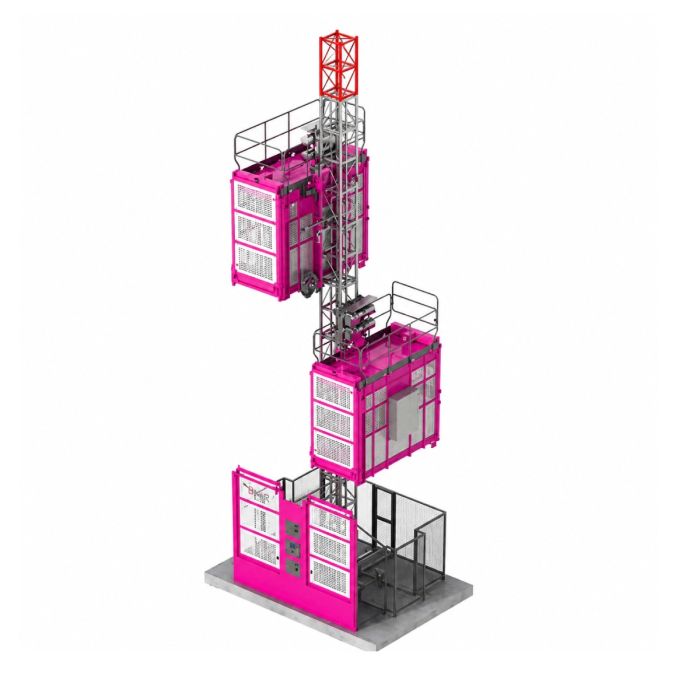
Every tower under construction has exactly one commute, and everything on the project stands in line for it. The hoist is the vertical main street of a high-rise site — every pallet, every crew, every machine that works above the ground floor gets there through a steel cage on a mast — and on a conventional site that street has a toll collector: a human operator whose shift hours, breaks and judgment calls set the tempo of the entire building. The BMR Intelligent Construction Hoist removes the toll booth. Built for smart construction projects as the twin-cage SC200/200ZA, it operates the way a finished building's elevator does, decades early: automatic landing doors open on arrival, external call buttons summon a cage from any level, in-cage floor selection dispatches it, and dual-cage control coordinates both 2,000-kilogram cars — each a full 3.2 by 1.5 by 2.45 metres — up masts installed to 242 metres, at travel speeds to 36 metres per minute on twin 15-kilowatt drive sets per cage, under real-time safety monitoring throughout. Then comes the feature that reveals whose site this machine was really designed for: through its integrated vertical logistics scheduling system, the hoist takes calls from robots. BMR's construction machines interact with it automatically — summoning a cage, boarding, riding to their assigned floor and rolling off to work, no human escort required — which turns the fleet's one hard boundary, the floor slab, into a scheduling detail, and turns night hours, when human operators go home, into the robots' open road.
The Intelligent Construction Hoist is available for purchase internationally through this page, with delivery, customs clearance and after-sales support arranged for buyers across Europe, the Americas, the Middle East, Asia-Pacific and worldwide.
Background
The bottleneck economics of going up
Vertical transport is the quietest schedule-killer in high-rise construction. Studies of tower logistics keep finding the same pattern: trades lose working hours queueing for cage space, materials arrive on floors out of sequence, and hoist availability — not crane capacity, not labour — caps how many crews a core can feed. Automation attacks every term of that equation. Call-and-dispatch operation means the cage is moving whenever demand exists, not whenever an operator is on shift; scheduling software sequences deliveries instead of first-come queues; dual-cage coordination doubles throughput on one mast; and round-the-clock availability converts the site's dead hours into logistics hours. BMR builds the hoist as the circulatory system of its intelligent-construction model — the "Auxiliary" category in a portfolio where everything else does the building, and this one machine makes sure everything else is on the right floor.
The robot fleet's missing limb
Shenzhen BrightMaster Robotics — full-stack developer, global exclusive agent of the Bozhilin construction-robot portfolio, with more than 5,200 robots delivered across 1,600-plus projects and a cumulative built area beyond 40 million square metres, including landmark overseas batch construction in Hong Kong — fields floor, wall, concrete and measuring robots that are autonomous on their own storey and helpless beyond it. A grinding robot that must wait for a human to escort it upstairs is only as autonomous as that human's timesheet. The intelligent hoist closes exactly that gap: barrier-free interfloor transport for robots, negotiated machine-to-machine through the vertical logistics scheduler, so a fleet redeploys itself overnight — coating robots migrating up as floors cure, the measuring robot touring acceptance scans, dispatch following the construction plan rather than the escort roster. The accompanying safety management system completes the operational case, giving the factory, rental and engineering service providers, and the general contractor shared full-lifecycle supervision of the equipment — the audit trail vertical transport has always needed and rarely had.
Technical Specifications
| Parameter | Intelligent Construction Hoist SC200/200ZA |
|---|---|
| Configuration | twin cage, dual-cage coordinated control |
| Rated load capacity | 2 × 2,000 kg |
| Cage dimensions (L×W×H) | 3.2 × 1.5 × 2.45 m per cage |
| Maximum installation height | 242 m |
| Lifting speed | 0–36 m/min |
| Motor power | 2 × 2 × 15 kW |
| Operation | automatic landing doors; external floor calls; in-cage floor selection; automated dispatch |
| Robot integration | vertical logistics scheduling system; automated interaction with construction robots for barrier-free interfloor transport |
| Safety | real-time safety monitoring; safety management system with full-lifecycle supervision for factory, rental/engineering providers and general contractor |
| Role | vertical logistics backbone for smart building projects and multi-robot construction fleets |
Mast sections, landing-door provisioning, installation engineering and site-specific configuration are confirmed at quotation.
What changes when the hoist answers its own calls?
The site gets a second working day. A human-operated hoist is productive for one shift, idle for two — and every idle hour is a floor-bound fleet. Automated call-and-dispatch operation makes the mast a 24-hour utility: materials staged overnight ride up before the morning crews arrive, robots relocate between storeys while the site sleeps, and the day shift starts with its logistics already done rather than queued. Within working hours, the gains compound through coordination — two cages under one scheduler serve calls the way a modern elevator bank does, cutting the wait-time tax every trade currently pays, while floor-call operation means a two-minute delivery no longer costs a forty-minute operator round-trip. And because the scheduler is the same digital layer that dispatches BMR's robots and reports into project dashboards, vertical transport stops being a verbal arrangement at the gate and becomes what the rest of the smart site already is: planned, logged, and visible to the people accountable for the programme.
Who is the Intelligent Construction Hoist for?
For general contractors delivering high-rise residential, commercial and public towers, where a 242-metre-capable, twin-cage automated mast converts the project's scarcest shared resource into scheduled capacity; for smart-construction programmes deploying robot fleets — BMR's or mixed — for which robot-callable vertical transport is the difference between storey-bound machines and a self-redeploying workforce; for equipment rental and engineering service companies, whose business the full-lifecycle safety management system was explicitly architected to include, with supervision shared across factory, provider and contractor; for developers and owners mandating digitally documented, continuously monitored site logistics; and for any builder whose critical path keeps tripping over the cage queue at level one. It pairs naturally with every working robot in BMR's portfolio — the machines it exists to deliver to their floors.
What is the Intelligent Construction Hoist used for?
- High-rise material logistics: automated, scheduled vertical delivery of materials across twin 2,000-kilogram cages.
- Personnel transport: elevator-style call-and-select movement of crews through the construction phase.
- Robot fleet redeployment: barrier-free interfloor transfer of construction robots via machine-to-machine dispatch.
- Night-shift logistics: unattended staging and repositioning during hours a human-operated hoist stands idle.
- Smart-site integration: vertical transport as a scheduled, logged node in the project's digital construction system.
- Managed equipment programmes: rental and service deployments under shared full-lifecycle safety supervision.
Pricing and Availability
The Intelligent Construction Hoist is available for purchase and international delivery through this page, as a single twin-cage installation or across multiple masts for large footprints, configured with mast height, landing doors and scheduling integration to the project — and specified alongside BMR's construction robots where a coordinated smart-site fleet is the goal. Price and cost depend on installation height, configuration, integration scope, commissioning and training, and quantity, so buyers should request a current quotation for their project profile; delivery, customs clearance and after-sales support are arranged worldwide. Purchase enquiries, datasheets and availability details for the Intelligent Construction Hoist are available on this page.
Frequently Asked Questions
What is the BMR Intelligent Construction Hoist?
An automated twin-cage construction elevator — the SC200/200ZA — for smart building projects: two 2,000-kilogram cages serving installations to 242 metres with automatic doors, floor-call dispatch, dual-cage control, real-time safety monitoring and integration that lets construction robots ride it unaided.
How does it differ from a conventional construction hoist?
It operates itself: external calls and in-cage selection replace the dedicated operator, a scheduling system sequences demand across both cages, and availability extends around the clock — while a safety management platform gives factory, rental provider and contractor shared lifecycle oversight.
How do robots actually use it?
Through the vertical logistics scheduling system: a BMR construction robot requests a cage, boards through the automatic doors, is carried to its target floor and continues its task — barrier-free interfloor transport that lets a robot fleet redeploy across storeys without human escort.
What are its capacity and reach?
Each of the two cages is rated at 2,000 kilograms with internal dimensions of 3.2 by 1.5 by 2.45 metres — full pallet and equipment scale — travelling at up to 36 metres per minute on masts installed to 242 metres.
Does automation compromise safety?
It formalises it: real-time monitoring runs continuously, and the dedicated safety management system was designed for full-lifecycle quality and safety supervision shared between the manufacturer, rental or engineering service provider and the general contractor — a documented chain conventional hoists rarely offer.
Who stands behind the machine?
Shenzhen BrightMaster Robotics — global exclusive agent of the Bozhilin construction-robot portfolio and a full-stack developer with more than 5,200 robots delivered, 1,600-plus projects and over 40 million square metres built, including batch construction in Hong Kong.
Where can I buy the Intelligent Construction Hoist and what does it cost?
The Intelligent Construction Hoist is available through this page, with delivery, customs clearance and after-sales support arranged for buyers worldwide. Because cost varies with mast height, configuration, integration and quantity, buyers should request an individual quotation. All purchasing details are available on this page.
Summary
The Intelligent Construction Hoist automates the one machine every other machine on a tower depends on: the cage on the mast that decides when materials, crews and robots reach their work. Twin 2,000-kilogram cars answering calls to 242 metres, doors that open themselves, a scheduler that serves robots and humans alike, and a safety system that keeps three parties supervising one asset — it converts vertical transport from the site's bottleneck into its best-run utility, and converts BMR's storey-bound fleet into a workforce that commutes on its own. On the smart site, the building still goes up one floor at a time; with this machine, so does everything else, at any hour. For contractors done queueing at level one, this page is the starting point.