
SIASUN Outdoor Trackless Guided Heavy Payload Mobile Robot (Harbour)
متوفر
- ماركة:
- SIASUN
- نموذج:
- OUTDOOR TRACKLESS GUIDED HEAVY PAYLOAD MOBILE ROBOT (HARBOUR)
- ORIGIN:
- الصين
- Warranty:
- 12 MONTHS
- AVAILABILITY:
- FOR OPPORTUNITIES OVER 1 MILLION USD
- SKU:
- SIASUN-outdoor-trackless-guided-heavy-payload-mobile-robot-harbo
SIASUN Outdoor Trackless Guided Heavy Payload Mobile Robot (Harbour)
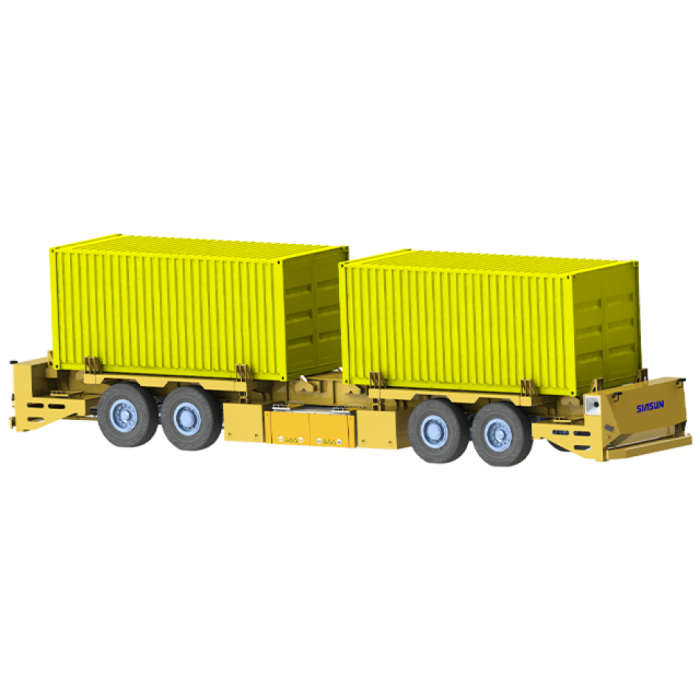
As container ships grow larger, the bottleneck in many terminals is no longer the crane but the short trip between quay and yard. Every container lifted off a ship has to be carried to a stack, and every minute a crane waits for a truck is lost capacity. SIASUN's Outdoor Trackless Guided Heavy Payload Mobile Robot (Harbour) is built to remove that wait. It is an unmanned vehicle that collects containers under the ship to shore crane, drives itself across the terminal and hands them to the yard crane, without rails, wires in the pavement or a driver.
Background
SIASUN is a Chinese robotics and automation company with a broad range of mobile robots, from compact factory AMRs to heavy duty mobile robots rated in tens of tonnes. Its harbour robot, often called a port IGV (intelligent guided vehicle), is the outdoor, container scale end of that range. SIASUN has developed port vehicles with the terminal operator PSA since 2017 and reports nearly 200 of its port mobile robots in service at Tuas Port in Singapore. The company also states that the robot has been exported to other major ports.
How It Works
- Quay side. The ship to shore crane lifts a container from the vessel and sets it directly onto a waiting robot.
- Transfer. The robot drives unmanned to the yard, following routes assigned by the terminal's dispatch system and changing lanes when the system calculates a better path.
- Yard side. On entering the yard's handover area, the yard crane lifts the container off and the robot returns for the next move.
The vehicle stops automatically when an obstacle is detected, and self test and fault diagnosis functions flag problems early so the fleet keeps moving.
Key Specifications
| Specification | SIASUN Harbour Mobile Robot |
|---|---|
| Robot type | Outdoor trackless guided heavy payload mobile robot (port IGV) |
| Load configurations | 2 × 20 ft containers, 2 × 20 ft tanks, 1 × 40 ft container, 1 × 45 ft container |
| Heavy load capability | Up to 95 t (manufacturer figure)* |
| Top travel speed | Up to 7 m/s (manufacturer figure)* |
| Positioning accuracy | ±5 cm (manufacturer figure) |
| Navigation options | Inertial, magnetic pegs, RTK differential GNSS, UWB, laser contour, vision, 5G, GPS |
| Energy | Swappable heavy duty battery, about 5 minute swap (manufacturer figure) |
| Operation | Unmanned, dispatched by terminal management system |
*Rated payload, loaded and unloaded speeds, gradeability, dimensions and battery capacity depend on configuration. Confirm them with SIASUN for your terminal layout.
Features
Trackless Navigation
The robot can combine several positioning methods: inertial guidance, magnetic pegs set in the pavement, RTK differential GNSS, UWB, laser contour matching, vision, 5G positioning and GPS. Using more than one source lets it keep its position near cranes, between stacks and under steel structures, where a single signal can drop out. SIASUN quotes positioning accuracy of ±5 cm, enough to line up under crane spreaders.
Flexible Load Handling
One deck handles the main container formats found in a terminal. It can carry two 20 ft units in tandem, two 20 ft tank containers, or a single 40 ft or 45 ft box, so the same fleet serves mixed vessel calls.
Battery Swapping for Continuous Duty
Instead of parking to recharge, the robot exchanges its heavy battery pack, which SIASUN states can weigh up to 7 tonnes, at a swap station in about five minutes. Vehicles return to work almost immediately, which keeps fleet size down for a given throughput.
Agile Traffic Handling
The control system plans wedge shaped lane changes so robots can pass one another and work around queues, improving flow in busy lanes.
Built In Diagnostics
Self test, self assessment and early fault judgement help maintenance teams act before a problem stops a vehicle.
Applications
- Automated container terminals. Horizontal transport between ship to shore cranes and the container yard.
- Terminal upgrades. Replacing manned trucks in existing terminals without laying rails or wires.
- Inland and river ports. Container moves between quay, yard and rail or truck interfaces.
- Large outdoor logistics sites. Heavy unit loads moved across open yards where trackless navigation is needed.
Explore related ranges in transportation robots, logistics robots and autonomous mobile robots.
Which Should You Buy?
| Model | Payload class | Best for |
|---|---|---|
| SIASUN Harbour Mobile Robot | Container loads | Quay to yard container transport in ports |
| SIASUN 80T Heavy Duty Mobile Robot | 80 t | Very heavy components and assemblies |
| SIASUN 60T Heavy Duty Mobile Robot | 60 t | Large structures and heavy molds |
| SIASUN 30T Heavy Duty Mobile Robot | 30 t | Heavy plant logistics |
| SIASUN 10T Heavy Duty Mobile Robot | 10 t | Dies, coils and machine parts |
The harbour robot is designed specifically for containers and outdoor terminal work. For non container loads, compare the SIASUN heavy duty mobile robots and confirm each model's suitability for outdoor use.
Before You Buy
- Model your throughput. Fleet size depends on crane cycle times, travel distance, loaded speed and battery swap capacity. Ask for a simulation of your terminal.
- Confirm rated load and loaded speed. Treat the 95 t and 7 m/s figures as separate maximums and confirm rated payload and speed when loaded.
- Choose the navigation mix. Decide which positioning methods suit your site, and whether pavement pegs or RTK base stations are needed.
- Plan the energy system. Battery swap stations, spare packs and charging power must be part of the project.
- Integrate with the TOS. The robot works through a dispatch system that must connect to your terminal operating system and crane control.
- Check environmental needs. Confirm operation in your temperature range, rain, wind and salt air, and the safety concept for mixed traffic areas.
Pricing and Availability
The SIASUN harbour mobile robot is supplied as part of a port automation project, so pricing depends on fleet size, navigation infrastructure, battery swap stations, software integration and site services. Request a quote from this page and our team will work with you on scope, lead time and support.
Frequently Asked Questions
What containers can it carry?
Two 20 ft containers, two 20 ft tank containers, or one 40 ft or 45 ft container per trip.
Does it need rails or wires in the ground?
No. It is trackless. It positions itself with a combination of methods such as RTK GNSS, UWB, laser contour, vision and inertial guidance, and can use magnetic pegs where extra accuracy is needed.
How accurate is its positioning?
SIASUN quotes ±5 cm, which allows precise handover under quay and yard cranes.
How does it stay charged?
It uses battery swapping. SIASUN states a heavy battery pack can be exchanged in about five minutes.
Is it already used in real ports?
Yes. SIASUN reports nearly 200 of its port mobile robots operating at Tuas Port in Singapore and states that the robot has been exported to other major ports.
Can it work with my terminal operating system?
The robot runs under a dispatch system that links to the terminal's management and crane systems. Integration is defined during the project.
Where can I buy the SIASUN harbour mobile robot?
You can request a quote directly on this page. Our team will confirm scope, pricing and delivery for your port.
Summary
SIASUN's harbour mobile robot automates the busiest link in a container terminal: the move from quay crane to yard. It carries all common container formats, navigates without tracks using multiple positioning methods, swaps batteries in minutes and diagnoses itself, with a growing record in large port deployments. Request a quote on this page to plan a fleet for your terminal.