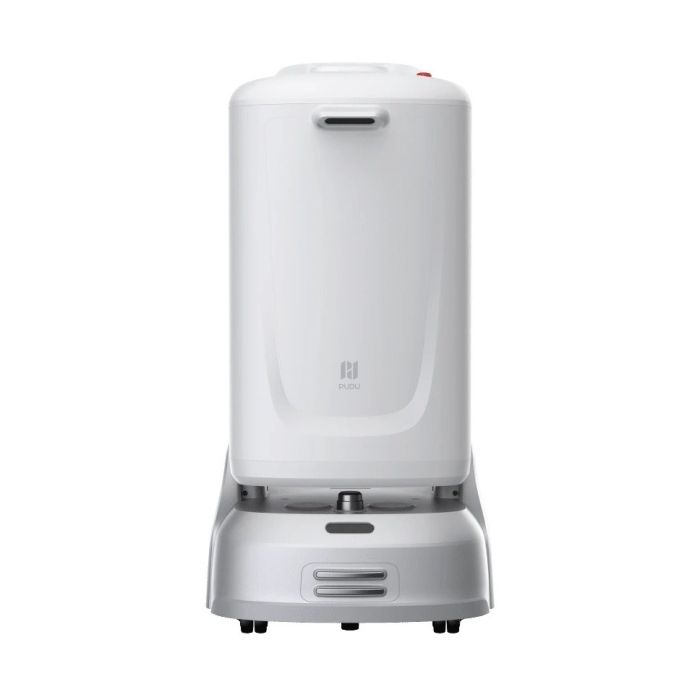
PUDU Flashbot Max Buliding Delivery Robot
In stock
- ماركة:
- PUDU ROBOTICS
- نموذج:
- FLASHBOT MAX
- ORIGIN:
- الصين
- AVAILABILITY:
- SUBJECT TO AVAILABILITY
- SKU:
- Pudu-FlashBot-Max
In a tall building, the longest part of a delivery is rarely the walk down a corridor. The time goes into waiting at the elevator, swiping through a turnstile, or pulling a staff member away from the front desk to carry a phone charger up twelve floors. The PUDU Flashbot Max Buliding Delivery Robot is built for that vertical problem rather than the horizontal one. Instead of an open tray, it carries goods in lockable compartments. It talks to the building's own terminal devices to call lifts and pass gates, and it finds its way with a navigation system that Pudu engineered for the semi-outdoor stretches common in hotels: covered walkways, garden paths and the passage between a main tower and its annex.
The FlashBot Max is available through this page by quotation. Send a request describing your building type, floor count, elevator brand and access-control arrangements, and a quotation is prepared for your project.
Background
Pudu Robotics and its commercial service focus
According to the company's published profile, Pudu Robotics was founded in 2016 and is headquartered in Shenzhen. It describes itself as a national high-tech enterprise covering the design, research and development, production and sales of commercial service robots. That focus on commercial rather than domestic machines shapes the FlashBot Max. It is intended to work through long shifts in busy, shared spaces where guests, tenants and staff move around it, and where reliability matters more than novelty.
VSLAM+ navigation and a building that cooperates
Two technologies define the FlashBot Max. The first is PUDU VSLAM+, a visual localisation and mapping system that the manufacturer says is engineered specifically for semi-outdoor hotel environments. These spaces are partly sheltered but exposed to changing light and open layouts. The second is IoT integration. Rather than pressing buttons or relying on staff to hold doors, the robot communicates with terminal devices in the building to place automatic calls, pass turnstiles and ride elevators without manual intervention. Together, these let a single robot cover a whole property instead of a single floor.
Technical Specifications
| Specification | Value |
|---|---|
| Version | FlashBot Max |
| Dimensions | 21.18*21.02*41.42 in (538 mm*534 mm*1052 mm) |
| Machine weight | 132.28 lbs (60 kg) |
| Payload per layer | 22.05 lbs/layer (10 kg/layer) |
| Single compartment | 7.36*16.14*11.02 in (187 mm*410 mm*280 mm) |
| Double compartment | 14.96*16.14*11.02 in (380 mm*410 mm*280 mm) |
| Run-time | 9 h |
| Charging time | 4 h |
| Cruise speed | 1.64 ft/s–3.94 ft/s (0.5 m/s ~ 1.2 m/s), adjustable |
| Navigation | PUDU VSLAM+, engineered for semi-outdoor hotel environments |
| Obstacle avoidance | Multiple sensor fusion with 3D perception for low and overhanging obstacles |
| Compartment access | Password, phone number verification, NFC |
| Compartment hygiene | Continuous fan ventilation against odours and bacteria |
| Charging | Returns to its charging station automatically when the battery is low |
| Building integration | IoT communication with terminal devices for automatic calls, turnstile access and elevator use |
| Mapping | Rapid multi-floor map replication |
| Elevator compatibility | Reported: cloud-based elevator systems from major brands such as KONE and OTIS without modification, plus a hardware solution |
| IP rating | Not published; confirmed at quotation |
| Battery capacity | Not published; confirmed at quotation |
| Operating temperature | Not published; confirmed at quotation |
| Connectivity (network interfaces) | Not published; confirmed at quotation |
| Noise level | Not published; confirmed at quotation |
| Power supply input | Not published; confirmed at quotation |
Specifications are as published by the manufacturer and are confirmed against the current datasheet at quotation.
What sets FlashBot Max apart from an open-tray service robot?
Restaurant service robots are usually designed for short, supervised runs between kitchen and table. Food sits on open trays, and the person at the table simply lifts it off. That model breaks down in a hotel or office tower, where the recipient may be twenty floors away behind a closed door and the item may be a parcel, a document or medication rather than a plate.
The FlashBot Max answers with enclosed compartments. Each one opens only after password entry, phone number verification or an NFC tap, so the item reaches the person it was meant for. The compartments are sized for real building traffic. The single format is 187 mm*410 mm*280 mm and the double format 380 mm*410 mm*280 mm, which leaves room for a takeaway bag, a stack of towels or a box of supplies. Each layer carries up to 10 kg. Continuous fan ventilation keeps the interior from holding food odours between runs, which matters when the same robot carries a meal on one trip and fresh linen on the next.
Movement is the other difference. Multi-sensor fusion gives the robot 3D perception, so it reacts to low objects such as luggage wheels and to overhanging ones such as table edges or protruding signage, not just to obstacles at sensor height.
Can FlashBot Max ride elevators on its own?
Yes, and this is the core of the design. Through its IoT connection, the robot communicates with terminal devices in the building to call an elevator, pass a turnstile and complete the trip without anyone stepping in. Per the published product information, it supports cloud-based elevator systems from major brands such as KONE and OTIS without modifications. Where a cloud connection is not available, a hardware solution is also offered. This compatibility comes from a single source, so it should be confirmed against your specific elevator installation at quotation.
Multi-floor map replication supports the same goal. Once one floor has been mapped, the map can be replicated rapidly across floors with similar layouts. This shortens commissioning in towers with repetitive floor plates, such as hotels with identical guest-room corridors.
Who is FlashBot Max for?
The clearest fit is the hotel operator. Room-service orders, amenity requests and forgotten-item deliveries all run vertically, and the VSLAM+ system was engineered for hotels' semi-outdoor areas. Resort-style properties with garden corridors or detached wings can extend the robot's reach beyond the main building.
Office towers and mixed-use buildings form the second group. Mailrooms, reception desks and catering teams can send documents, parcels and meal orders to tenant floors through turnstiles and elevators. The verified compartments reduce the risk of items going to the wrong desk in a multi-tenant environment.
A third group is facilities with internal logistics between floors, such as residential complexes and healthcare or institutional buildings, where traceable, secure handover matters. For any segment with outdoor exposure beyond semi-sheltered areas, note that the IP rating and operating temperature range are not published. They should be clarified at quotation before planning routes. The fact sheet names only the FlashBot Max version, so no sibling configuration is compared here.
What is FlashBot Max used for?
- Hotel room service: carrying meals and drinks from the kitchen to guest-room doors across floors.
- Amenity requests: bringing towels, toiletries, chargers and similar items on demand without tying up front-desk staff.
- Office parcel distribution: moving mail and packages from the reception desk to tenant floors through turnstiles and elevators.
- Takeaway handover: receiving courier orders at the lobby and delivering them to residents or employees in locked compartments.
- Internal document transfer: shuttling confidential paperwork between departments with password, phone or NFC verification.
- Resort and campus routes: linking buildings through covered walkways and semi-outdoor paths suited to VSLAM+ navigation.
Pricing and Availability
The FlashBot Max is supplied by quotation, so the offer reflects your building, your elevator system and your integration needs. Include your elevator brand, the number of floors and any turnstile or access-control systems in your request. These details determine whether the cloud-based or hardware elevator solution applies. Delivery, customs and support are arranged with the quotation. Request your quotation for the PUDU FlashBot Max, available on this page.
Frequently Asked Questions
How much can FlashBot Max carry?
The published payload is 22.05 lbs (10 kg) per layer. The fact sheet does not state the number of layers in a given configuration, so total capacity is confirmed at quotation.
How long does it run on one charge?
The FlashBot Max has a run-time of 9 h and a charging time of 4 h. It returns to its charging station automatically when its battery runs low.
Can it work outside?
Its VSLAM+ navigation is engineered for semi-outdoor hotel environments such as covered walkways. The manufacturer has not published an IP rating or operating temperature range, so exposure to weather should be discussed at quotation.
How are delivered items protected?
Compartments open only after password entry, phone number verification or NFC sensing. Continuous fan ventilation keeps the interior free of odours and bacteria between deliveries.
Will it work with our elevators?
Per the published information, it supports cloud-based elevator systems from brands such as KONE and OTIS without modification, and a hardware solution is also available. Compatibility with your specific installation is confirmed at quotation.
How fast is deployment in a multi-storey building?
Rapid multi-floor map replication lets a mapped floor be reproduced across similar floors, which shortens setup. The actual commissioning schedule depends on the site and is set out with the quotation.
Where can I buy FlashBot Max and what does it cost?
The FlashBot Max is available through this page by quotation. Pricing depends on configuration, elevator integration and support, so send a request to receive an offer for your project.
Summary
Most delivery robots solve the walk across a room. The FlashBot Max is built to solve the climb through a building. Its VSLAM+ navigation handles the semi-outdoor spaces of hotels, and its IoT link calls elevators and passes turnstiles on its own. Verified compartments of 187 mm or 380 mm width carry 10 kg per layer, and a 9 h run-time with automatic recharging covers long service days. Some details remain unpublished, including the IP rating, battery capacity and power input, and these are clarified before any commitment. For hotels, offices and mixed-use buildings where the elevator lobby is the real bottleneck, this page is the starting point.