Robot Glossary
Buying, specifying or supporting a robot means reading datasheets written in three overlapping dialects at once: mechanical engineering, control theory and machine learning. This glossary decodes the terms that appear most often across humanoid, quadruped, collaborative and mobile robot documentation, in plain commercial English. Entries are listed alphabetically; where a term has a different meaning in industrial robotics than in AI research, both readings are given.
A
Absolute encoder — A position sensor that reports a joint's exact angle the moment power is applied, with no homing routine required. Robots that must resume work after a power cut generally use absolute rather than incremental encoders.
Actuator — The component that converts electrical power into motion. In modern humanoids an actuator is usually an integrated unit combining motor, gearbox, encoder and driver electronics in one housing.
Admittance control — A control mode in which the robot measures external force and responds by moving, producing a soft, "pushable" feel. Used for hand-guided teaching and for tasks where the robot must yield to contact.
AGV (Automated Guided Vehicle) — A mobile platform that follows a fixed, pre-installed route such as a magnetic strip, wire or reflector path. Simpler and cheaper than an AMR, but it cannot deviate around an obstruction.
AMR (Autonomous Mobile Robot) — A mobile platform that maps its environment and plans its own route, re-planning dynamically around people, pallets and parked equipment. The dominant format for warehouse transport, hospital logistics and indoor delivery.
Anthropomorphic — Built to human proportions and joint arrangement. Anthropomorphic design lets a robot use tools, doorways, stairs and workstations designed for people, avoiding facility redesign.
Articulated robot — A manipulator built from rotary joints in series, typically six. The classic industrial arm geometry, offering the widest range of approach angles for a given footprint.
Autonomy level — An informal scale describing how much human input a robot needs, from teleoperated at one end to fully autonomous mission execution at the other. Vendors use the term loosely, so always ask which specific decisions the robot makes unaided.
Axis — One controllable direction of movement. A six-axis arm has six independently driven joints; axis count is not the same as degrees of freedom once passive linkages are involved.
B
Backdrivability — The ability to move a robot's joint by pushing on it from the outside. Backdrivable joints make contact-rich tasks safer and are essential for force-sensitive manipulation.
Battery hot-swap — Exchanging a depleted battery for a charged one without shutting the robot down. The practical requirement for any machine expected to run across multiple shifts.
BLDC motor (brushless DC) — An electronically commutated motor with no mechanical brushes, offering high efficiency, long life and low maintenance. The standard prime mover in legged and collaborative robots.
Bin picking — Retrieving randomly oriented parts from an unstructured container. One of the hardest classic vision problems, since the robot must perceive, choose and grasp without a fixed part position.
Biped — A robot that walks on two legs. Bipedal locomotion buys human-environment compatibility at the cost of control complexity and energy consumption.
C
CAN bus / CAN FD — A robust serial communication standard originating in automotive electronics, widely used to link joints, hands and sensors. CAN FD is the higher-bandwidth successor, common in dexterous hands with many sensing channels.
Cartesian robot — A machine moving along three linear axes at right angles. Mechanically simple and very rigid, but limited to a rectangular working volume.
CE marking — The manufacturer's declaration that a product meets applicable EU health, safety and environmental requirements. For robots this normally involves the Machinery Regulation and, where radio modules are present, the Radio Equipment Directive.
Cobot (collaborative robot) — An arm designed to work alongside people without traditional safety fencing, using force limiting, speed limiting and contact detection. The safety case depends on the application and end effector, not on the arm alone.
Collision detection — Continuous monitoring of motor current or joint torque to identify unexpected contact and trigger a stop. Distinct from collision avoidance, which prevents contact using sensing and planning.
Compliance (mechanical) — Deliberate softness in a joint or structure, whether from series elastic elements or from control. Compliance protects both workpiece and robot during contact tasks.
Control loop — The repeating cycle of measure, compute, command that governs robot motion. Loop rate, quoted in hertz, is a strong indicator of how finely a machine can regulate force and position.
Cycle time — The elapsed time for one complete repetition of a task. The number most directly tied to return on investment, and the one worth measuring on your own parts rather than accepting from a brochure.
D
Dead reckoning — Estimating position by accumulating wheel rotation and inertial measurements from a known start point. Cheap and fast, but drifts over distance, so it is usually corrected by LiDAR or visual localisation.
Degrees of freedom (DOF) — The number of independent movements a robot or hand can make. Counting conventions vary widely between vendors, so check whether hands, waist and head are included in a headline figure.
Delta robot — A parallel-linkage machine with a lightweight moving platform driven by three or four arms from above. Built for extremely fast light picking in food and pharmaceutical packaging.
Depth camera — A camera that outputs distance per pixel as well as colour, using stereo, structured light or time of flight. The workhorse sensor for grasping, obstacle detection and scene understanding.
Dexterous hand — A multi-fingered end effector with enough articulation to reorient objects within the grasp rather than merely hold them. Specification hinges on active versus passive degrees of freedom, grip force and tactile sensing.
Digital twin — A physics-accurate virtual replica of a robot and its workspace, used to validate motion, train policies and rehearse deployments before hardware is committed.
Direct drive — A joint in which the motor drives the load without reduction gearing. Eliminates backlash and maximises backdrivability at the cost of torque density.
Drag teaching — Programming a path by physically moving the robot arm by hand while it records waypoints. The fastest route from operator knowledge to working program, and a core cobot selling point.
Duty cycle — The proportion of time a machine can operate at a given load before thermal or battery limits force a pause. A robot rated for continuous duty and one rated for intermittent duty are very different purchases.
E
Edge computing — Processing sensor data on the robot itself rather than in the cloud. Necessary wherever latency, connectivity or data residency rules out a round trip to a server.
Effective payload — The mass a robot can actually handle in the intended posture and at the intended speed, after subtracting the end effector. Frequently lower than the headline payload figure, which is usually quoted at best-case reach.
Embodied AI — Machine learning applied to systems that perceive and act in the physical world, where consequences are irreversible and data is expensive. The organising idea behind the current generation of general-purpose humanoids.
Encoder — A sensor reporting rotational or linear position. Dual-encoder joints, measuring before and after the gearbox, allow the controller to detect deflection and improve accuracy under load.
End effector — Whatever is mounted at the robot's wrist to do the actual work: gripper, hand, welding torch, suction array, camera or dispensing head.
EtherCAT — A high-speed industrial Ethernet protocol offering deterministic, low-jitter communication across many nodes. Common in high-performance arms, hands and whole-body humanoid control.
Exoskeleton — A wearable powered structure that augments or rehabilitates human movement. Related to robotics by actuator and control technology rather than by autonomy.
F
Fieldbus — Any industrial network linking controllers, drives and sensors, including EtherCAT, PROFINET, EtherNet/IP and CC-Link. Fieldbus compatibility determines how cleanly a robot integrates with existing plant equipment.
Fleet management — Software that coordinates many robots at once, handling task allocation, traffic, charging schedules and health monitoring. Beyond a handful of units, fleet software matters more than any single robot's specification.
Force control — Commanding a target contact force rather than a target position. Essential for assembly, polishing, insertion and any task where pressing too hard destroys the part.
Force-torque sensor — A wrist-mounted transducer measuring forces and moments in six directions. Provides the feedback signal that makes true force control possible.
Forward kinematics — Calculating where the end effector sits given all joint angles. The straightforward direction of the kinematics problem.
Foundation model — A large model pre-trained on broad data and adapted to specific tasks with comparatively little additional training. In robotics, foundation models aim to reduce per-task programming to demonstration and instruction.
FCC certification — Confirmation that a device's radio emissions comply with United States regulations. A prerequisite for lawfully marketing wireless-equipped robots in the US market.
G
Gait — The coordinated pattern of limb movement used for locomotion, such as trot, walk, bound or run. Gait quality is the most visible differentiator between legged robot generations.
Gantry robot — An overhead-mounted linear system spanning a work area, used where floor space is unavailable or spans are long. Common in machine tending and large-format handling.
Gearbox — The reduction stage converting fast, low-torque motor rotation into slow, high-torque joint motion. Harmonic drives offer zero backlash and high ratios; planetary and cycloidal designs favour shock tolerance and cost.
GNSS / RTK — Satellite positioning, and the correction technique that sharpens it to centimetre accuracy using a fixed reference station. Standard on agricultural, surveying and outdoor inspection machines.
Grasp success rate — The percentage of attempts in which a robot picks an object cleanly. Only meaningful alongside the object set, lighting and clutter conditions used in the test.
Gripper — A simple end effector, typically two-jaw parallel, angular or vacuum. Where a task allows a gripper, it will almost always beat a dexterous hand on cost, speed and reliability.
H
Hand-eye calibration — Establishing the precise geometric relationship between a camera and the robot it guides. Poor calibration is the most common cause of a vision-guided system missing by millimetres.
Haptics — Technology conveying touch information, whether to a human operator during teleoperation or between a robot's sensors and its controller.
HRI (human-robot interaction) — The design discipline governing how people and robots communicate, covering speech, gaze, screens, gestures and safe physical proximity. Decisive in customer-facing service deployments.
Humanoid — A robot with a broadly human body plan: torso, head, two arms and either legs or a wheeled base. The commercial argument is generality — one platform, many tasks, no facility redesign.
Hertz (Hz) — Cycles per second. Used for control loop rates, sensor sampling and image capture; higher figures mean finer regulation and lower latency.
I
IMU (inertial measurement unit) — A package of accelerometers and gyroscopes reporting orientation and acceleration. Indispensable for balance in legged robots and for smoothing navigation estimates in mobile ones.
Imitation learning — Training a robot policy from recorded human demonstrations rather than hand-written code or trial-and-error reward. The technique behind teleoperation-driven data collection rigs.
Industrial robot — A fast, rigid, high-accuracy manipulator built for repetitive production work, conventionally operated inside a guarded cell. Distinguished from a cobot by speed, payload and safety architecture.
Inverse kinematics — Calculating the joint angles required to place the end effector at a desired pose. Harder than forward kinematics, since solutions may be multiple or non-existent.
IP rating — A two-digit code stating resistance to solids and liquids, such as IP54, IP66 or IP67. The single most important specification for any robot leaving a clean indoor environment.
J
Jerk — The rate of change of acceleration. Limiting jerk produces smoother motion, less mechanical wear and better retention of delicate payloads.
Jogging — Manually driving a robot joint by joint or axis by axis, usually from a pendant or tablet, during setup and troubleshooting.
Joint — A powered connection between two rigid links, either rotary or linear. The joint is where torque, precision, thermal limits and cost are all decided.
Joint torque — The rotational force a joint can produce, in newton metres. Peak torque governs dynamic ability such as jumping or catching a load; rated torque governs sustained work.
K
Kinematic chain — The ordered sequence of links and joints from a robot's base to its end effector. Serial chains dominate arms; parallel chains appear in delta robots and some legged designs.
Kinematics — The mathematics of motion without reference to the forces causing it. The foundation layer beneath every motion planner and controller.
L
LiDAR — A sensor that measures distance by timing reflected laser pulses, producing precise range data in daylight or darkness. Two-dimensional units serve navigation; three-dimensional units serve mapping and full obstacle perception.
Linear actuator — A device producing straight-line motion, typically via ball screw, belt or rack. Used for lifting torsos, telescopic masts and vertical adjustment on mobile manipulators.
LLM (large language model) — A model trained to process and generate natural language. In robots it usually sits above the control stack, translating spoken instructions into task sequences.
Load-to-weight ratio — Payload capacity divided by the robot's own mass. A compact figure of merit for legged and mobile platforms, where every kilogram carried costs energy.
Localisation — Determining the robot's position within a known map. Distinct from mapping, though the two are solved together in SLAM.
Locomotion — The method by which a robot moves its whole body through space: wheeled, tracked, legged or hybrid wheel-legged.
M
Manipulator — The robot arm considered as a unit, from base to wrist flange, excluding the end effector.
Mecanum wheel — A wheel with angled rollers around its rim which, in a set of four, allows sideways and diagonal movement without turning. Common on omnidirectional indoor platforms.
Mobile manipulator — An arm mounted on a mobile base, combining transport with the ability to act on what it reaches. Wheeled humanoids are the most visible current example.
Motion capture — Recording human movement with markers or cameras for replay or retargeting onto a robot. Widely used to give humanoids naturalistic gaits and gestures.
MTBF (mean time between failures) — The statistical average operating time between breakdowns. The key input for spares planning and service-level commitments.
Multimodal — Processing several input types together, such as vision, audio, force and touch. Multimodal perception underpins reliable manipulation in unstructured spaces.
N
Navigation stack — The bundled software handling mapping, localisation, global route planning and local obstacle avoidance on a mobile robot.
Neural network — A trainable computational model that learns input-output relationships from examples. Now standard for perception and increasingly used for motion control itself.
Nominal payload — The manufacturer's rated carrying capacity under stated reference conditions. Read the footnotes before designing a workcell around it.
O
Obstacle avoidance — Detecting and routing around unexpected objects in real time, as opposed to following a fixed pre-planned path.
Odometry — Position estimation from motion sensing, whether wheel-based, visual or inertial. Cheap, continuous and prone to drift.
Omnidirectional — Able to translate in any direction and rotate independently, without needing to turn first. Valuable in aisles, lifts and crowded service environments.
Onboard compute — The processing hardware carried by the robot, typically an embedded AI module paired with a real-time motion controller. Determines what can run locally at speed.
Operating temperature range — The ambient span within which the robot meets its specifications. The figure that decides whether a machine can enter cold storage, foundries or open desert sites.
OTA update — Delivering firmware and software revisions over the network. The mechanism by which fleets gain capability after purchase, and a point worth checking in any service agreement.
P
Path planning — Computing a collision-free route from the current pose to a goal, subject to the robot's kinematic and dynamic limits.
Payload — The mass a robot can carry or manipulate. Always confirm whether the quoted figure includes the end effector and at what reach it applies.
Pick and place — Moving items from a source to a destination, the most common single robot application. Deceptively simple until parts arrive unsorted or unoriented.
Pitch, roll, yaw — The three rotational axes describing orientation: nose up or down, tilt sideways, and turn left or right about the vertical.
PLC (programmable logic controller) — The industrial controller coordinating machinery in a production line. Robot integration usually means exchanging signals with a PLC.
Point cloud — A set of three-dimensional points describing measured surfaces, produced by LiDAR or depth cameras. The raw material of mapping and object recognition.
Pose — Position and orientation together, six numbers in total. Robot targets are specified as poses, not merely positions.
Power-to-weight ratio — Available mechanical power divided by robot mass, in kilowatts per kilogram. A useful indicator of athletic capability in legged machines.
Proprioception — A robot's internal sense of its own joint positions, velocities and torques, as distinct from external sensing of the world.
Protective stop — A monitored halt triggered by a safety device or condition, from which the robot can resume once the cause clears. Different from an emergency stop, which removes power.
Q
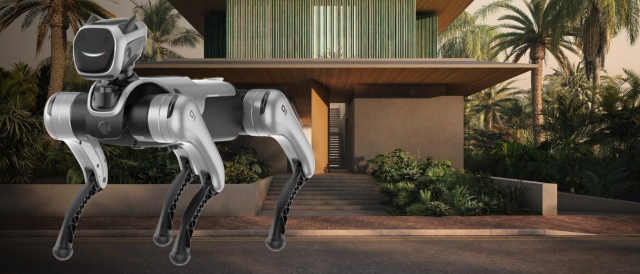
Quadruped — A four-legged robot. Static stability, good rough-terrain performance and a small footprint make quadrupeds the practical choice for inspection and patrol duties.
Quick-swap module — A subassembly designed for tool-free field exchange, such as a forearm, battery pack or sensor head. Modularity converts a repair into a swap and keeps fleets running.
R
Reach — The maximum distance from a robot's base to its wrist. Payload capacity typically falls as reach extends, so the two figures must be read together.
Reduction ratio — The ratio between motor rotation and joint rotation. Higher ratios trade speed and backdrivability for torque.
Reinforcement learning — Training by trial and error against a reward signal, usually in simulation before transfer to hardware. The technique behind most modern legged locomotion controllers.
Repeatability — How closely a robot returns to the same taught point on repeated attempts, quoted in millimetres. Distinct from accuracy, which measures agreement with a commanded coordinate; industrial specifications almost always quote repeatability.
RGB-D camera — A camera delivering colour and depth in a single registered frame. The default perception sensor for manipulation.
Risk assessment — The formal analysis identifying hazards in a specific robot installation and the measures reducing them to acceptable levels. Required for compliant deployment, and the responsibility of the integrator or end user rather than the robot manufacturer alone.
ROS / ROS 2 — The open-source middleware framework providing standard messaging, tooling and driver interfaces for robots. ROS 2 adds real-time and security features suited to commercial products.
Runtime — Operating duration on a full charge. Compare figures at realistic duty cycles, since idle and full-load runtimes can differ by a factor of two or more.
S
Safety-rated monitored stop — A state in which the robot holds position under power while a person is present, resuming automatically once the workspace clears.
SCARA — A four-axis arm rigid vertically and compliant horizontally, optimised for high-speed assembly and insertion on a plane.
SDK (software development kit) — The libraries, documentation and examples letting customers program a robot directly. SDK depth separates a research platform from a closed appliance.
Sensor fusion — Combining several sensors into a single, more reliable estimate than any one could provide alone, such as LiDAR with inertial and visual data.
Servo — A motor with closed-loop position feedback, continuously correcting toward the commanded target.
Simulation — Testing robot behaviour in a physics engine before touching hardware. Sim-to-real transfer, and the domain gap it must overcome, is the central practical problem in learned control.
Singularity — A configuration in which a manipulator loses a direction of movement and joint speeds spike toward impractical values. Planners are written to route around them.
SLAM (simultaneous localisation and mapping) — Building a map of an unknown space while tracking position within it. The capability that makes an AMR deployable without facility modification.
Speed and separation monitoring — A collaborative safety method that slows or stops the robot as a person approaches, based on continuous distance measurement.
Stereo vision — Deriving depth from two offset cameras by triangulation, mirroring human binocular vision.
T
Tactile sensor — A sensor detecting contact force, pressure distribution, slip or texture. Tactile feedback allows a hand to hold a fragile object firmly enough without crushing it.
TCP (tool centre point) — The reference point at the working tip of the end effector, to which all programmed positions are referred. Defining it correctly is a prerequisite for accurate work.
Teach pendant — The handheld or tablet interface used to jog, program and operate a robot on the shop floor.
Teleoperation — Direct human control of a robot at a distance, using VR headsets, motion-tracked gloves, joysticks or exoskeleton rigs. Increasingly used to gather demonstration data as much as to perform tasks.
Tendon drive — Transmitting force through cables from motors placed away from the joint, keeping fingers and limbs light. Standard in dexterous hands, where distal mass limits speed.
Throughput — Units processed per hour. The commercial measure that matters, and the one to validate against your own parts and layout.
TOPS (tera operations per second) — A measure of AI accelerator throughput, quoted for onboard compute modules. Useful for comparing hardware classes, but a poor proxy for real task performance on its own.
Trajectory — A planned path with timing attached, specifying not just where the robot goes but the velocity and acceleration profile it follows.
U
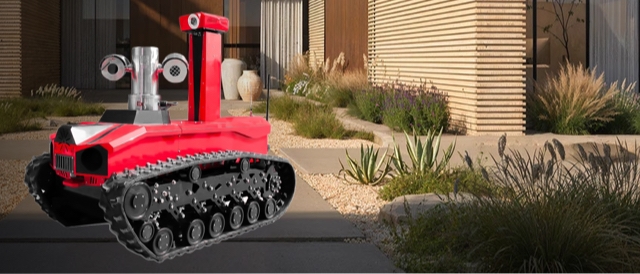
UGV (unmanned ground vehicle) — An uncrewed wheeled or tracked outdoor vehicle, typically used for inspection, security, defence or agriculture.
Ultrasonic sensor — A short-range proximity detector using sound pulses. Inexpensive and reliable on transparent or glossy surfaces that defeat optical sensing.
Underactuation — Having fewer motors than degrees of freedom, with mechanical linkages coupling the remainder. A common approach in robot hands, delivering adaptive grasping at low cost and weight.
URDF (Unified Robot Description Format) — The standard file describing a robot's links, joints, limits and geometry. Required for simulation, planning and most learning pipelines.
UWB (ultra-wideband) — A short-range radio positioning technology giving centimetre-level indoor location where satellite signals are unavailable.
V
VLA model (vision-language-action) — A model that maps camera input and a natural-language instruction directly to robot actions. The architecture behind claims of zero-shot task generality in current humanoid platforms.
Visual servoing — Closing the control loop on camera data, continuously correcting motion until the target appears correctly in frame. Tolerates part position variation that fixed programs cannot.
Visuotactile sensing — Sensing touch by filming the deformation of a soft, camera-backed fingertip, giving very high spatial resolution of the contact patch.
VSLAM — SLAM performed primarily with cameras rather than LiDAR. Lower cost and lighter, though more sensitive to lighting and featureless surfaces.
W
Wading depth — The water depth a mobile robot can traverse without ingress. Relevant to outdoor inspection, flood response and wash-down environments.
Waypoint — A defined intermediate pose along a programmed route.
Wheel-legged robot — A hybrid using powered wheels at the ends of articulated legs, rolling efficiently on flat ground and stepping over obstacles when required. The fastest-growing quadruped format for industrial inspection.
Whole-body control — Coordinating every joint at once, including torso and legs, to achieve a task while maintaining balance. What allows a humanoid to reach low or lean into a load without falling.
Working envelope — The three-dimensional volume a robot's end effector can reach. The primary constraint when laying out a cell or workstation.
X, Y, Z
X, Y, Z axes — The three linear directions of Cartesian space, which together with pitch, roll and yaw define a full six-degree-of-freedom pose.
Zero-shot generalisation — Performing a task the model was never explicitly trained on. The headline capability claim of foundation-model robotics, and the one most worth testing on your own objects.
Zero-torque mode — A state in which joints exert no active force and can be moved freely by hand, used for teaching, transport and maintenance.
Zone (safety zone) — A configured region of space with its own speed or access rules, allowing a robot to run fast where nobody stands and slow where people pass.
Frequently Asked Questions
What is the difference between repeatability and accuracy?
Repeatability describes how tightly a robot clusters around the same taught point across many attempts; accuracy describes how closely it reaches a coordinate it was commanded to but never physically taught. Most datasheets quote repeatability because it is the better figure and, for taught-path industrial work, the more relevant one. Vision-guided and offline-programmed applications depend on accuracy, which usually requires calibration.
Is payload the same as lifting capacity?
Not reliably. Quoted payload often excludes the end effector, assumes a favourable posture and applies at reduced speed. For legged and mobile machines, separate figures frequently exist for continuous carrying, peak lift and static load, and they can differ substantially.
What do IP ratings mean in practice?
The first digit covers solid ingress and the second covers liquids. IP54 suits general indoor use with incidental dust and splash; IP66 withstands dust and powerful water jets, suiting outdoor and wash-down work; IP67 adds temporary immersion. A robot's overall rating may differ from that of individual assemblies, so confirm which parts are covered.
Does a collaborative robot remove the need for safety fencing?
Not automatically. Collaborative operation is a property of the complete application, including the end effector, workpiece, speed and layout, and it must be established through a risk assessment. A cobot arm makes fenceless operation achievable, not guaranteed.
How many degrees of freedom does a humanoid actually need?
It depends entirely on the task. Higher counts extend the range of reachable postures and the dexterity available for manipulation, but they add cost, mass, power draw and maintenance points. Since vendors count hands, waist and head inconsistently, compare specifications on the individual joint breakdown rather than the headline number.
What is the difference between an AGV and an AMR?
An AGV follows infrastructure installed in the building and stops when its route is blocked. An AMR builds and uses its own map, plans routes independently and drives around obstructions, which makes it far more adaptable in changing layouts at a higher unit cost.