UBTECH Walker S2 Industrial Humanoid Robot + Free Delivery Anywhere in Asia
In stock
- BRAND:
- UBTECH
- MODEL:
- WALKER S2
- ORIGIN:
- China
- Warranty:
- 12 MONTHS
- AVAILABILITY:
- ALLOW 2-4 WEEKS FOR DELIVERY
- SKU:
- UBTECH-Walker-S2
UBTECH Walker S2 Industrial Humanoid Robot + Free Delivery Anywhere in Asia
Designed primarily for research institutions, educational facilities, and commercial service applications, the Walker S2 showcases UBtech's commitment to developing practical humanoid robots that can interact naturally with humans and navigate dynamic environments. With its 41 degrees of freedom, advanced computer vision systems, and robust bipedal locomotion capabilities, the Walker S2 stands as one of the most sophisticated commercially available humanoid robots on the market.
This article provides a comprehensive examination of the UBtech Walker S2, including its technical specifications, design philosophy, real-world applications, and position within the competitive landscape of humanoid robotics.
Design and Features
Physical Specifications
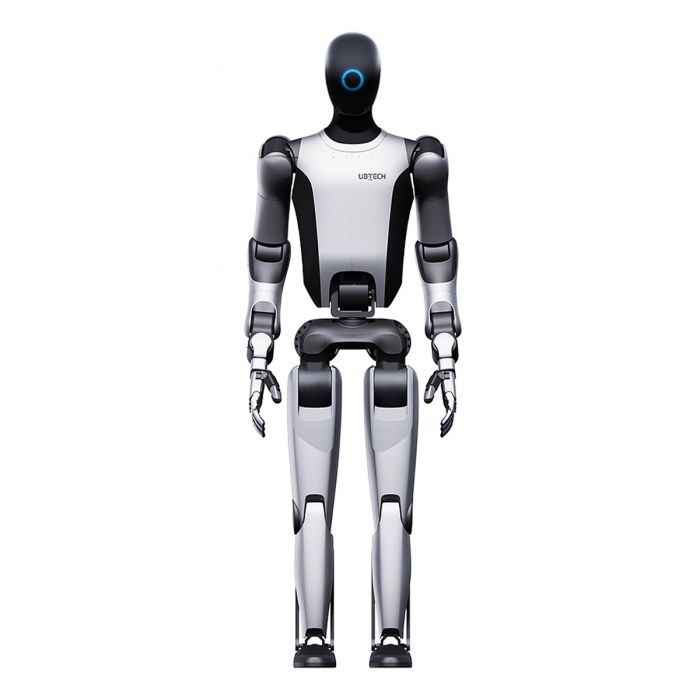
The UBtech Walker S2 is engineered with human-like proportions and dimensions, standing approximately 1.45 meters (4.75 feet) tall and weighing around 77 kilograms (170 pounds). This compact form factor allows the robot to navigate environments designed for human use, including standard doorways, corridors, and commercial spaces.
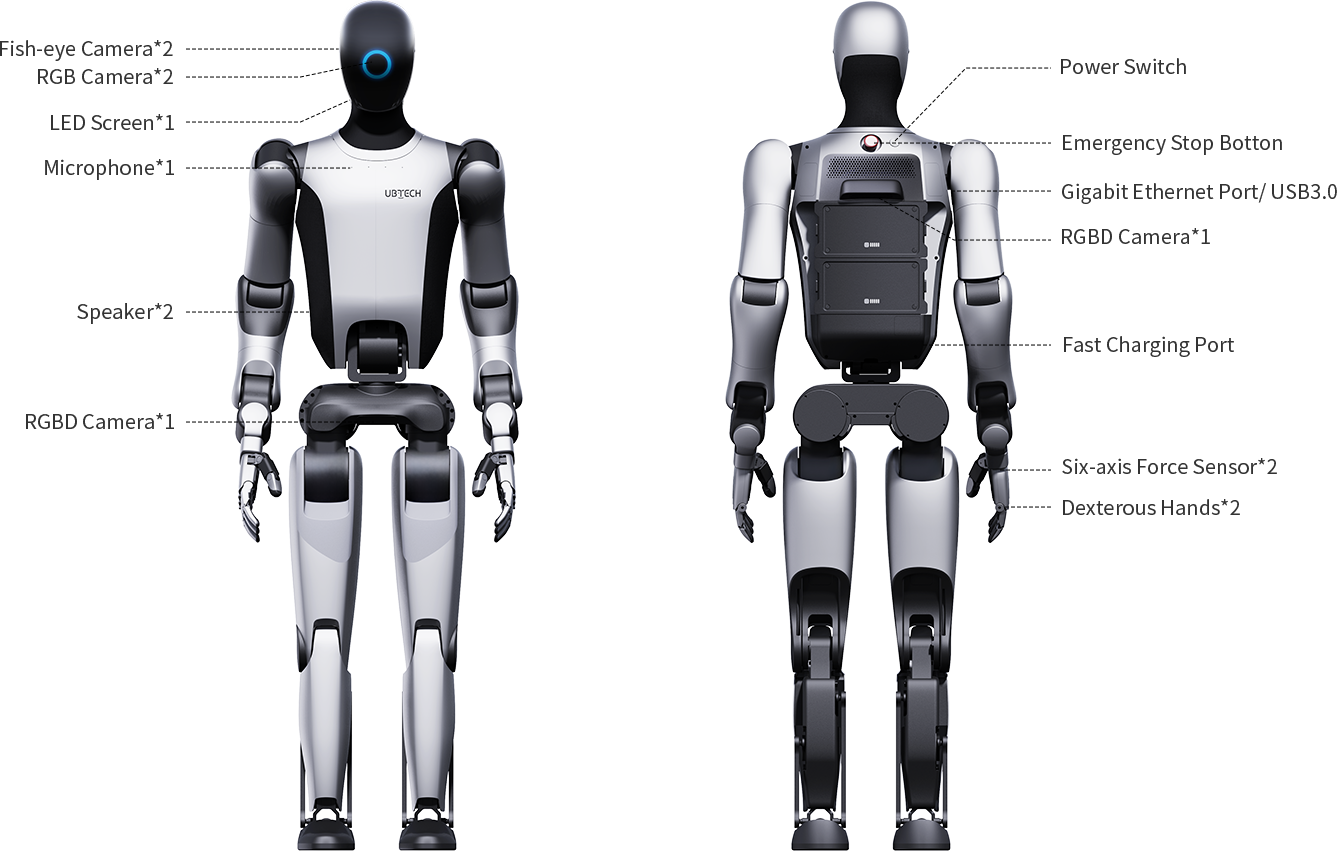
The robot's physical construction emphasizes both durability and aesthetic appeal. The Walker S2 features a sleek, modern design with smooth contours and a predominantly white exterior accented by black and blue elements. This design language conveys approachability while maintaining a professional appearance suitable for public-facing service applications.
Degrees of Freedom and Mobility
One of the Walker S2's most impressive features is its 41 degrees of freedom (DOF) distributed throughout its mechanical structure. This extensive articulation enables fluid, natural movement patterns that closely mimic human motion. The degrees of freedom are strategically allocated across the robot's body:
- Head and neck: Multiple DOF for natural head movements and gaze direction
- Arms and hands: Extensive articulation enabling precise manipulation and gesture recognition
- Torso: Flexible spine-like structure for balance and natural posturing
- Legs and feet: Advanced bipedal locomotion system with ankle, knee, and hip articulation
The robot's bipedal walking capability represents a significant engineering achievement. The Walker S2 can maintain stable locomotion across flat surfaces, navigate inclines, and adapt to various floor types. Its walking speed reaches approximately 3 kilometers per hour (1.86 mph), suitable for indoor service environments.
Sensory Systems
The Walker S2 incorporates a sophisticated sensory array that enables environmental perception and human interaction:
Vision Systems: Multiple cameras positioned in the head provide stereoscopic vision for depth perception, object recognition, and facial identification. These cameras support the robot's computer vision algorithms for navigation and task execution.
Audio Systems: Built-in microphones and speakers facilitate natural voice interaction, enabling the robot to understand spoken commands and respond with synthesized speech.
Tactile Sensors: Force-torque sensors in the hands and feet provide haptic feedback, allowing the robot to gauge grip pressure and maintain balance on uneven surfaces.
Environmental Sensors: Additional sensors monitor temperature, humidity, and other environmental factors to ensure safe operation.
Technology and Specifications
Artificial Intelligence and Computing
The Walker S2 operates on a powerful onboard computing platform capable of processing complex AI algorithms in real-time. The robot's artificial intelligence framework encompasses several key capabilities:
Computer Vision: Advanced object detection and recognition algorithms enable the Walker S2 to identify and track objects, people, and environmental features. The system can recognize faces, interpret gestures, and understand spatial relationships.
Natural Language Processing: The robot processes spoken language in multiple languages, understanding context and intent to provide appropriate responses and execute commands.
Motion Planning: Sophisticated algorithms calculate optimal movement trajectories, ensuring smooth, efficient motion while avoiding obstacles and maintaining balance.
Machine Learning: The Walker S2 can learn from experience, adapting its behavior based on interactions and environmental feedback.
Hardware Specifications
Height: 1.45 meters (4.75 feet)
Weight: 77 kilograms (170 pounds)
Degrees of Freedom: 41 DOF
Walking Speed: Up to 3 km/h (1.86 mph)
Battery Life: Approximately 2-4 hours of continuous operation (varies by activity)
Charging Time: 2-3 hours for full charge
Payload Capacity: Up to 3 kilograms (6.6 pounds) per hand
Operating Temperature: 0°C to 40°C (32°F to 104°F)
Software and Operating System
The Walker S2 runs on a proprietary operating system developed by UBtech, built on a Linux-based foundation. This software platform provides:
- Real-time control of all 41 degrees of freedom
- Integration of sensory data from multiple input sources
- API access for custom application development
- Cloud connectivity for remote monitoring and updates
- Safety protocols and emergency stop mechanisms
Applications and Use Cases
Research and Development
The Walker S2 serves as an advanced research platform for institutions studying humanoid robotics, artificial intelligence, and human-robot interaction. Its sophisticated hardware and open software architecture enable researchers to:
- Develop and test new locomotion algorithms
- Explore human-robot collaboration scenarios
- Study bipedal balance and stability mechanisms
- Advance machine learning applications in robotics
Service and Hospitality
In commercial settings, the Walker S2 functions as an interactive service robot capable of:
Reception and Greeting: The robot can welcome visitors, provide directions, and answer frequently asked questions in hotels, museums, shopping centers, and corporate facilities.
Information Dissemination: With its natural language processing capabilities, the Walker S2 delivers information about products, services, exhibits, or facilities.
Light Assistance: The robot can carry small items, guide visitors through facilities, and perform simple delivery tasks.
Education and Training
Educational institutions utilize the Walker S2 for:
- STEM education programs focusing on robotics and AI
- Demonstrations of advanced robotics concepts
- Interactive learning experiences for students
- Training programs for future robotics engineers
Entertainment and Exhibitions
The Walker S2's impressive appearance and capabilities make it suitable for:
- Technology exhibitions and trade shows
- Science museums and technology centers
- Corporate events and product launches
- Entertainment venues seeking interactive attractions
Advantages and Benefits
Technical Advantages
Advanced Mobility: The 41 degrees of freedom provide exceptional movement flexibility, enabling the robot to perform tasks requiring human-like dexterity and range of motion.
Stable Bipedal Locomotion: Unlike wheeled robots, the Walker S2's bipedal design allows navigation of stairs, uneven terrain, and environments optimized for human mobility.
Sophisticated AI Integration: The combination of computer vision, natural language processing, and machine learning creates a robot capable of intelligent, context-aware interactions.
Modular Architecture: The robot's design facilitates maintenance, upgrades, and customization for specific applications.
Practical Benefits
Human-Centric Design: The Walker S2's anthropomorphic appearance and behavior patterns facilitate natural human-robot interaction, reducing user anxiety and increasing acceptance.
Versatility: The robot's capabilities span multiple application domains, providing value across research, commercial, and educational sectors.
Continuous Improvement: Cloud connectivity enables software updates and feature enhancements, extending the robot's useful lifespan and capabilities.
Safety Features: Multiple redundant safety systems protect both the robot and humans in its environment.
Comparisons with Other Humanoid Robots
Walker S2 vs. Other Leading Humanoid Robots
The humanoid robotics market features several notable competitors, each with distinct characteristics:
Boston Dynamics Atlas: While Atlas demonstrates superior athleticism and dynamic movement capabilities, including running and jumping, it remains primarily a research platform rather than a commercial product. The Walker S2 prioritizes stability and practical service applications over extreme mobility.
SoftBank Pepper: Pepper focuses primarily on social interaction and customer service, with a wheeled base rather than bipedal locomotion. The Walker S2 offers more advanced mobility and manipulation capabilities but at a higher price point.
PAL Robotics TALOS: TALOS targets research applications with a focus on whole-body control and manipulation. It offers similar technical sophistication to the Walker S2 but typically at a significantly higher cost.
Toyota T-HR3: Toyota's humanoid emphasizes teleoperation and remote control capabilities. The Walker S2 provides greater autonomous operation through its AI systems.
The Walker S2 occupies a middle ground in the market, offering advanced bipedal capabilities and AI integration at a price point more accessible than premium research platforms while providing greater sophistication than basic service robots.
Pricing and Availability
Cost Considerations
The UBtech Walker S2 is positioned as a premium humanoid robot with pricing that reflects its advanced capabilities. While official pricing varies by region and purchase configuration, the Walker S2 typically ranges from $150,000 to $300,000 USD depending on customization, support packages, and volume purchases.
This pricing structure places the Walker S2 in the high-end segment of commercial service robots but below the most expensive research platforms, which can exceed $500,000 or more.
Purchasing Options
Organizations interested in acquiring the Walker S2 can explore several purchasing pathways:
Direct Purchase: Organizations with sufficient budget can purchase the robot outright through UBtech's authorized distributors and sales channels.
Leasing Arrangements: Some distributors offer leasing programs that reduce upfront costs and include maintenance and support services.
Research Partnerships: Academic institutions and research facilities may access special pricing or partnership opportunities through UBtech's research collaboration programs.
Availability and Distribution
The Walker S2 is available through UBtech's global distribution network, with primary markets in:
- China (home market with most extensive availability)
- United States
- Europe (select countries)
- Asia-Pacific region
- Middle East (limited availability)
Prospective buyers should contact authorized UBtech distributors or the company directly for current availability, lead times, and region-specific pricing information.
Future Development and Updates
UBtech continues to develop and refine the Walker platform, with ongoing improvements expected in:
- Enhanced AI capabilities and decision-making algorithms
- Improved battery efficiency and extended operation time
- More sophisticated manipulation abilities
- Expanded language support and cultural adaptation
- Greater autonomy in complex environments
The company's commitment to software updates ensures that existing Walker S2 units can receive many of these improvements through over-the-air updates, protecting the investment value for early adopters.
Frequently Asked Questions (FAQ)
What is the UBtech Walker S2?
The UBtech Walker S2 is an advanced bipedal humanoid robot designed for research, service, and educational applications. It features 41 degrees of freedom, artificial intelligence capabilities including computer vision and natural language processing, and can walk, manipulate objects, and interact naturally with humans. The robot stands 1.45 meters tall, weighs 77 kilograms, and represents one of the most sophisticated commercially available humanoid robots on the market.
How does the Walker S2 robot work?
The Walker S2 operates through an integrated system of hardware and software components. Its 41 servo motors provide movement across joints throughout the body, controlled by sophisticated algorithms that maintain balance and coordinate motion. Multiple cameras and sensors provide environmental awareness, while onboard AI processors analyze this data to make decisions, recognize objects and people, understand spoken commands, and navigate autonomously. The robot's operating system coordinates all these functions in real-time, enabling complex behaviors and human-robot interactions.
What are the benefits of the UBtech Walker S2?
The Walker S2 offers several key benefits: it provides advanced research capabilities for institutions studying humanoid robotics and AI; serves as an engaging customer service platform in commercial environments; delivers hands-on STEM education opportunities; demonstrates human-like mobility that can navigate human-designed spaces; features sophisticated AI that enables natural interaction; and offers continuous improvement through software updates. Its bipedal design allows access to environments where wheeled robots cannot operate effectively.
Where can I buy the UBtech Walker S2?
The UBtech Walker S2 can be purchased through UBtech Robotics' authorized distributors and sales channels worldwide. Availability varies by region, with strongest distribution in China, the United States, Europe, and Asia-Pacific countries. Interested organizations should contact UBtech directly through their official website or reach out to authorized regional distributors for pricing, availability, and purchasing options. Some distributors offer leasing arrangements in addition to outright purchase.
Why is the Walker S2 important for robotics development?
The Walker S2 represents an important milestone in making advanced humanoid robotics more accessible for practical applications. While previous humanoid robots were primarily research curiosities or extremely expensive prototypes, the Walker S2 bridges the gap between cutting-edge technology and commercial viability. It demonstrates that sophisticated bipedal robots with AI capabilities can operate reliably in real-world service environments, advancing the field toward broader adoption of humanoid robotics in everyday life.
How long does the Walker S2 battery last?
The UBtech Walker S2 operates for approximately 2-4 hours on a single charge, depending on the intensity and type of activities performed. Active walking and manipulation tasks consume more power than stationary interactions. The robot requires 2-3 hours for a full recharge. For extended operation periods, organizations can implement rotation schedules with multiple charging stations or maintain backup power solutions.
What programming languages does the Walker S2 support?
The Walker S2 provides API access for custom application development, typically supporting popular robotics programming frameworks including ROS (Robot Operating System) compatibility. Developers can work with languages such as Python, C++, and other languages common in robotics development. UBtech provides software development kits (SDKs) and documentation to facilitate custom programming and integration with existing systems.
Summary
The UBtech Walker S2 represents a significant achievement in commercially available humanoid robotics, combining advanced bipedal mobility, sophisticated artificial intelligence, and practical service capabilities in a platform accessible to research institutions, educational facilities, and commercial enterprises. With its 41 degrees of freedom, comprehensive sensory systems, and continuous development support from UBtech Robotics, the Walker S2 stands as a compelling option for organizations seeking to implement humanoid robotics in real-world applications.
As humanoid robotics continues to evolve, the Walker S2 exemplifies the current state of the art in robots designed to operate safely and effectively alongside humans in everyday environments. Its balance of technical sophistication, practical functionality, and relative accessibility positions it as an important platform for advancing the field and exploring the future potential of human-robot collaboration.
Specifications
General
Physical
Mobility
Performance
Sensors
Connectivity
Software
Battery + Power
Shipping
Videos